


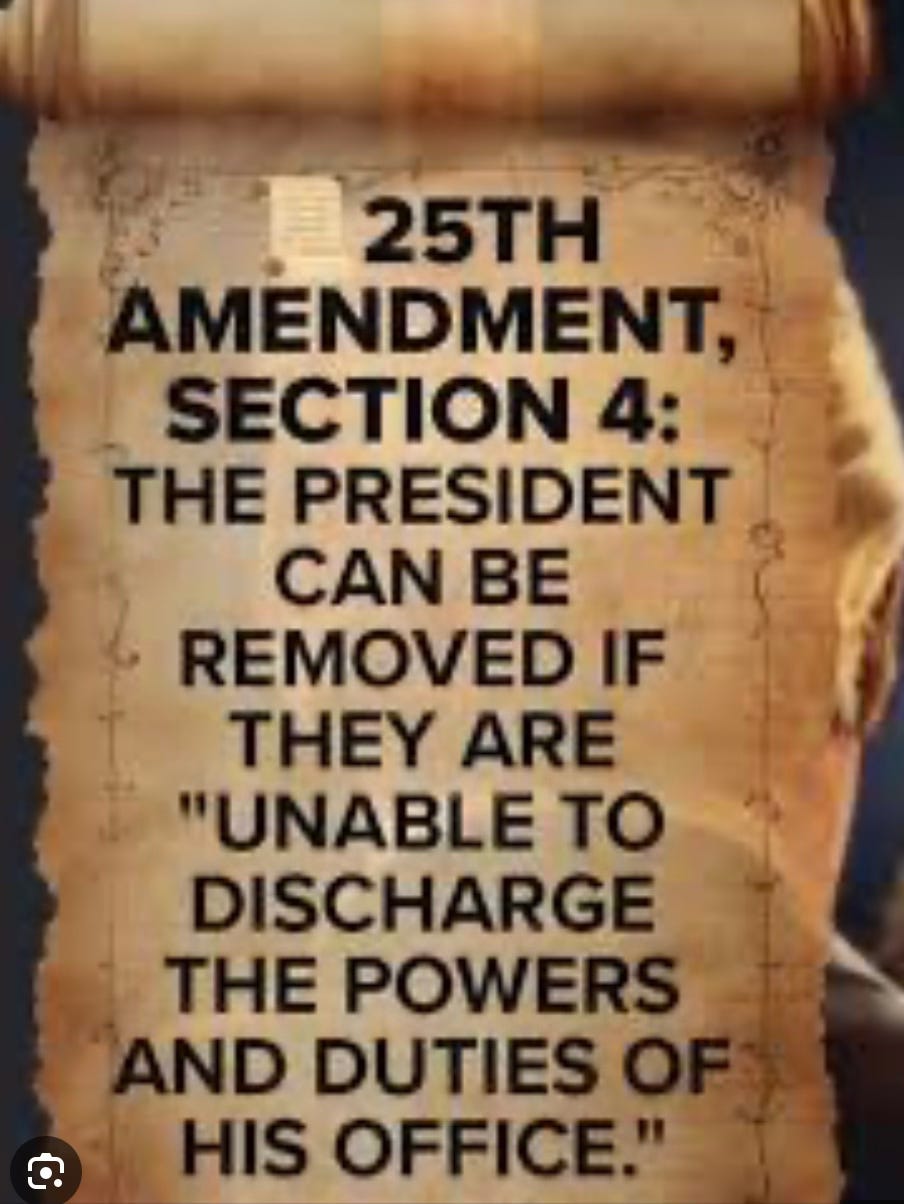
Increasingly, something buried deep in the Constitution is becoming a daily topic of conversation: Section 4 of the Twenty-fifth Amendment to the United States Constitution. I think we should have a clear understanding of just how this works, understanding the use of the 25th Amendment is far from a casual or easy mechanism available for transferring Presidential authority. Indeed, that is the way it was designed in 1967.
Section 4 is often discussed as if it were a political maneuver—a kind of constitutional escape hatch. It’s not. It was never intended to be. It is something much more serious: a safeguard for the rare moment when the presidency itself becomes uncertain.
On paper, the process is clear enough.
If a president is unable to carry out the duties of the office—and cannot or will not say so—the vice president and a majority of the Cabinet can act. They send a written declaration to Congress, and immediately the vice president becomes Acting President.
But that’s only the first step.
A president can contest that decision. If that happens, authority returns to the president unless the vice president and Cabinet act again within four days. If they do, Congress is drawn in, and it takes a two-thirds vote in both the House and Senate to keep the vice president in charge.
That’s not a loophole. That’s a barrier.
And it was designed that way.
A Moment That Stays With You
I didn’t come to appreciate these provisions from reading about them. I saw them up close.
During my time in the Reagan-Bush White House, I served as Chief of Staff to Vice President George H. W. Bush. When President Ronald Reagan underwent surgery in July, 1985, we prepared for the temporary transfer of presidential authority.
For eight hours, Vice President Bush served as Acting President.
That situation fell under Section 3—the voluntary transfer of power—not Section 4. The moment was explained in a New York Times article. While it was stated that Section 3 provisions were not formally invoked, the process closely followed the prescribed process.
The experience left a lasting impression. No one treated it casually. There was no sense of theater in the room. There was a clear understanding that the Constitution was not theoretical. It was operating in real time. And, I should add, Acting President George H.W. Bush stayed close to home and issued no directives or statements during the eight hour period.
Why Section 4 Is So Hard to Use
Section 4 addresses a more difficult scenario: a president who cannot perform the job but does not—or cannot—step aside.
To act under those circumstances requires an extraordinary alignment:
A vice president willing to act against a president
A majority of the Cabinet willing to agree
And, if challenged, two-thirds of both houses of Congress willing to sustain that judgment
In today’s environment, that level of agreement is hard to imagine. And that is precisely the point.
The amendment was written to function only when the situation is unmistakable—when the facts are so clear that political differences give way to institutional responsibility.
Not Removal—Capacity
There is also a persistent misunderstanding worth clearing up.
Section 4 does not remove a president from office in the way impeachment does. The president remains in office. What changes is who exercises the powers of the presidency.
It is not about punishment. It is about capacity.
That distinction matters. The Constitution is not trying to resolve political disputes here. It is trying to ensure continuity—steady hands on the wheel—when uncertainty could otherwise take hold.
The Wisdom of a High Bar
In the decades since the 25th Amendment was ratified, Section 4 has never been successfully invoked.
Some see that as proof it is unnecessary. I see it as evidence of careful design.
The country needs to know that in a true crisis, there is a constitutional path forward. But it also needs confidence that the path cannot be used casually, or impulsively, or as a substitute for politics.
That tension—between availability and restraint—is where the wisdom lies.
When It Really Matters
Having been inside the White House during even a brief and orderly transfer of power, I came away with a deeper respect for how much our system depends not just on the Constitution, but on the seriousness of those entrusted with it.
The 25th Amendment is not self-executing. It requires judgment. It requires restraint. And above all, it requires people willing to put the country ahead of everything else in a moment that may offer no easy answers.
Section 4 is one of those provisions we hope never to use.
But if that day ever comes, it will not feel like a headline or a talking point. It will feel like what it is: a test of whether the system can hold when the stakes are highest.
And in that moment, the question will not be whether the Constitution provides a process.
It will be whether we are equal to it.
That is the best explanation I have read about the 25th. Never would the cabinet be united to suppress trump--more like they just keep enabling him. And 2/3 of Congress--forget it. So we are stuck since until we change the composure of congress impeachment is also off the books yet we are stuck with a man who potentially could ignite the world. Read ON THE BEACH for a prescient prediciton.
Very good! As a Trump supporter (in most things) I appreciate your motivation in bringing this to our attention, but that does not detract from the value of the essay.